SLS
Selective Laser Sintering
What is SLS?
SLS (Selective Laser Sintering) is a 3D printing technology that uses a laser to fuse powdered materials, layer by layer, into solid structures. The process requires no support structures as unsintered powder acts as a natural support, enabling the creation of complex geometries. Known for its ability to produce strong, durable parts, SLS is ideal for functional prototypes and low-volume production.

SLS
Selective Laser Sintering
What is SLS?
SLS (Selective Laser Sintering) is a 3D printing technology that uses a laser to fuse powdered materials, layer by layer, into solid structures. The process requires no support structures as unsintered powder acts as a natural support, enabling the creation of complex geometries. Known for its ability to produce strong, durable parts, SLS is ideal for functional prototypes and low-volume production.
Materials available for SLS
Material | Color | Technology | Features | Applications | Datasheet |
|---|---|---|---|---|---|
Nylon PA12 | Black | SLS | Excellent chemical resistance, high impact strength and flexibility | Functional prototypes and end-use parts, automotive components (fuel systems, connectors) | Download |
Nylon PA12 GF | Grey | SLS | Reinforced with glass fibers for improved stiffness and strength, higher dimensional stability compared to standard PA12 | Automotive parts (brackets, housings, covers), structural components, jigs and fixtures | Download |
Advantages and drawbacks of SLS
Advantages
Excellent mechanical properties with high strength and durability.
No need for support structures, enabling complex geometries.
Wide range of materials, including polymers and composites.
Good for functional prototypes and small-batch production.
Suitable for creating lightweight parts with intricate designs.
Powder acts as natural support, minimizing post-processing requirements.
Drawbacks
Rough surface finish compared to SLA; requires post-processing for smoothness.
Higher equipment and material costs than some other technologies.
Cooling times can be long due to heat retention in the powder bed.
Limited color options, as parts are typically monochrome.
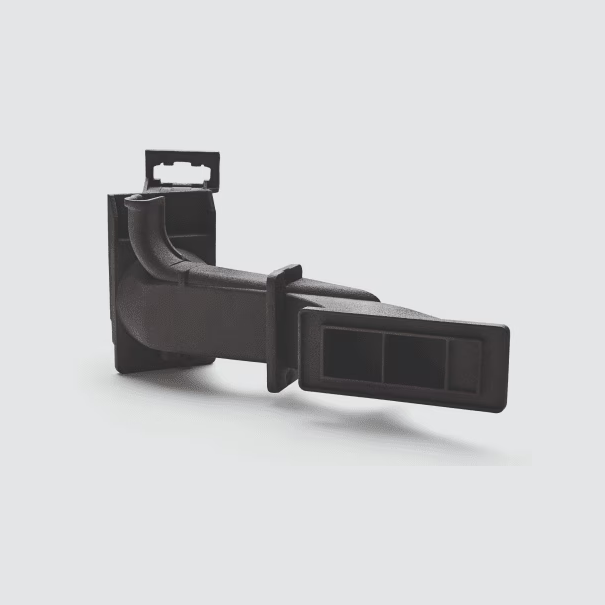

Materials available for SLS
Advantages
Excellent mechanical properties with high strength and durability.
No need for support structures, enabling complex geometries.
Wide range of materials, including polymers and composites.
Good for functional prototypes and small-batch production.
Suitable for creating lightweight parts with intricate designs.
Powder acts as natural support, minimizing post-processing requirements.
Drawbacks
Rough surface finish compared to SLA; requires post-processing for smoothness.
Higher equipment and material costs than some other technologies.
Cooling times can be long due to heat retention in the powder bed.
Limited color options, as parts are typically monochrome.
Advantages and drawbacks of SLS


